Walk deal to declaration without losing the pure sequence
A clear sequence of decisions turns rummy from a noise game into a teachable routine. The walkthrough below focuses on what an adult beginner can verify on the table card.

The deal: thirteen cards and one face-up
Verify the deck composition and joker type before you play your first card.
Indian rummy uses a standard 52-card deck plus printed jokers (some apps add a wild two). Each player receives 13 cards face-down; one card is placed face-up to start the open discard pile. The remaining deck becomes the closed stock pile.
Your first job is not to find a pure sequence immediately. It is to sort your 13 cards by suit and rank so you can see what is plausibly a pure run and what is not.

Sort for the cheapest pure sequence first
The pure sequence is the spine of every Indian rummy show. Without it, you cannot declare.
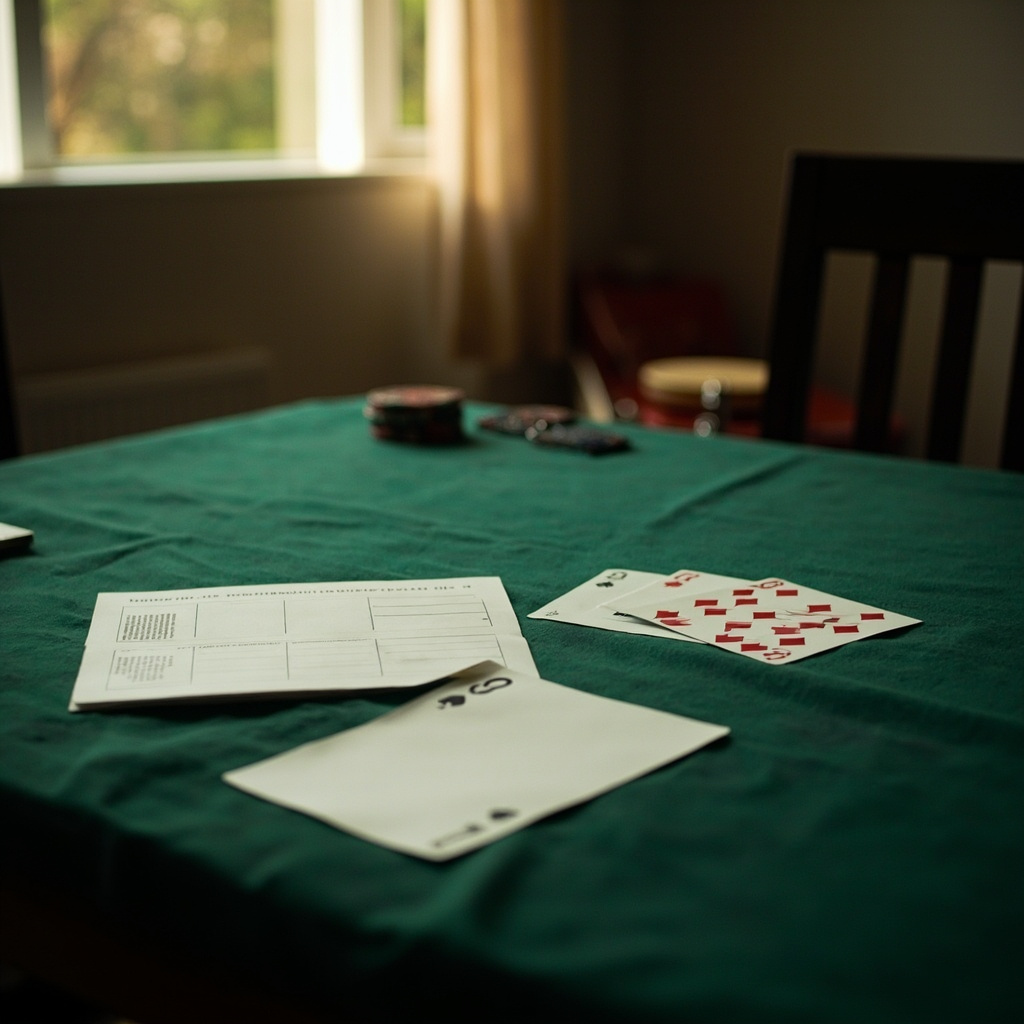
Pure sequence means consecutive cards of one suit with no joker substitution. Sort by suit first, then by rank, and look for a three- or four-card run that requires no wild card. This is your declaration insurance: even if everything else fails, you have the spine.
Once the pure sequence is identified, the next step is checking for a second sequence (it can be impure, with a joker substitute) or a set of equal rank in different suits.
Draw, watch and discard
Every turn is a small decision under incomplete information. Pattern-spotting helps, but it does not eliminate variance.
Choose between closed and open
Picking from the closed deck usually costs you nothing extra; picking from the open discard pile signals interest to other players.
Track open information
Discards show what others refuse. Repeated refusals of high cards from one suit hint at someone's collected suit.
Discard high deadwood
If you must drop something loose, prioritise high face cards and jokers that are not part of any meld. Avoid breaking your pure-sequence path.
Re-price the drop
If pure shape is gone and deadwood is rising, an early drop may cost less than fighting to declare.
The declaration moment
Speed without an audit is the most common cause of invalid shows.

When you press declare, the table verifies whether your remaining 13 cards form at least two valid sequences (one pure) plus sets as needed. An invalid declaration triggers the heavy penalty defined on the table card.
Always perform a five-step audit: (1) count sequences, (2) confirm one pure run, (3) verify no suit-clashing sets, (4) verify jokers are placed correctly, (5) confirm deadwood sums match the table convention.
Scoring after a valid show
Ungrouped cards become deadwood against the winner. Drop penalties are settled separately.
| Outcome | Settlement |
|---|---|
| You win with a valid show | Other players pay the sum of their deadwood values to you |
| You drop | You pay the drop penalty defined on the table card |
| You declare invalidly | You pay the maximum penalty; the hand continues |
| Other players declare | Your deadwood is paid to them per the table convention |
What happens in the first thirty seconds
After the deal, you hold thirteen cards. The first thirty seconds are not for hunting flashy sets. They are for sorting by suit and rank so you can see what is plausibly a pure run and what is not. Adults who skip the sort and start picking from the open pile regularly discover that they have broken a pure-sequence path they never noticed.
Sort by suit first, then by rank inside each suit. Look for a three- or four-card run that requires no wild card. That run is your declaration insurance. Even if everything else fails, you have the spine. Once the pure sequence is identified, the next step is checking for a second sequence (it can be impure, with a joker substitute) or a set of equal rank in different suits.
If the first thirty seconds produce no pure path, re-price the drop immediately. A first drop taken before your first turn concludes is the cheapest exit on most tables. Fighting a hand with no pure path is how beginners turn a small fixed penalty into a maximum deadwood bill.
Draw decisions under incomplete information
Every turn is a small decision under incomplete information. Picking from the closed deck usually costs you nothing extra in information leakage; picking from the open discard pile signals interest to other players. That signal is not always bad — sometimes you want the card more than you want secrecy — but it is a signal. Treat it as one.
Discards show what others refuse. Repeated refusals of high cards from one suit hint at someone’s collected suit. The evidence is incomplete. It narrows the probability distribution; it does not eliminate uncertainty. Adults who treat discard reads as certainty regularly walk into a show that was always available to an opponent who simply waited.
When you must discard, prioritise high face cards and jokers that are not part of any meld. Avoid breaking your pure-sequence path. A king that is not in a run or set is expensive deadwood if someone else declares. A three that is part of a pure path is insurance. The distinction is obvious on paper and easy to forget mid-hand.
The five-step declaration audit
When you press declare, the table verifies whether your remaining thirteen cards form at least two valid sequences (one pure) plus sets as needed. An invalid declaration triggers the heavy penalty defined on the table card. Speed without the audit is the most common cause of invalid shows among adults who already know the rules.
The five-step audit: (1) count sequences, (2) confirm one pure run with no joker inside it, (3) validate sets for suit clashes, (4) verify jokers are placed correctly, (5) confirm deadwood sums match the table convention. The audit takes under thirty seconds once it becomes a habit. The cost of skipping it is the maximum penalty on most tables.
Practice the audit on a low-stake Points table before you sit a higher band. Muscle memory for the audit is cheaper to build at low stakes than to discover at high stakes after an invalid show.
Five beginner mistakes that survive into month two
- Treating a joker-substituted run as the pure-sequence requirement
- Holding high face cards “just in case” long after pure shape has died
- Skipping the first-drop window because the hand “feels close”
- Declaring without counting sequences out loud or on paper
- Chasing a single lost hand by raising the next stake band
None of these mistakes are moral failures. They are process failures. Adults who name them in a private notebook reduce their frequency faster than adults who pretend the mistakes were bad luck.
Beginner questions, editor answers
How many cards does each player receive?
Indian rummy uses a 52-card deck plus jokers; players receive 13 cards each in standard formats, with one card face-up for the open deck.
When does the first turn start?
The player to the right of the dealer draws first. Subsequent turns alternate draw and discard until a valid show or all players drop.
What is a valid first drop?
A first drop is a drop taken before your first turn concludes; the penalty is fixed low on most tables. Always check the table card for the exact value.
Can a joker form part of a pure sequence?
No. A pure sequence cannot include a joker substitute. Use jokers for impure sequences or sets, never as the spine of a pure run.
What happens if I declare with an invalid show?
You incur the invalid-show penalty (often the maximum deadwood value) and the hand usually continues with other players. The exact penalty is on the table card.
How long does a beginner-friendly hand usually take?
A relaxed Points hand with three opponents often takes 8–15 minutes including showdown; longer if table chat is enabled.
Is this guide sponsored by the operator?
No. This is independent editorial work. The commercial CTA at the bottom uses a disclosed first-party redirect that may earn a commission.
Does the commercial button change the rule information?
No. Rules are verified against the operator screen and the publicly available rule strip. The CTA is unrelated to the technical accuracy of the content.
Are the listed stakes and limits guaranteed?
No. Stake ranges, drop values and invalid-show penalties change with each operator update. Always read the on-screen table card before joining.
How often is the hub updated?
Editorial notes are reviewed each quarter and updated whenever a relevant rule or product change is verified. Dates appear on the methods colophon.
Open a practice Points table to test the walkthrough
After reading the walkthrough, the next step is a low-stake Points table where the rules are visible on-screen. The lobby is the source of truth for drop values and joker behaviour.
PLAY NOWDisclosed first-party route. Editorial notes are independent of the commercial relationship.