Indian rummy formats, broken down by what actually changes session risk
Format choice changes session length, elimination pressure and how often drop decisions matter. Here is what adults should know before picking a lobby.
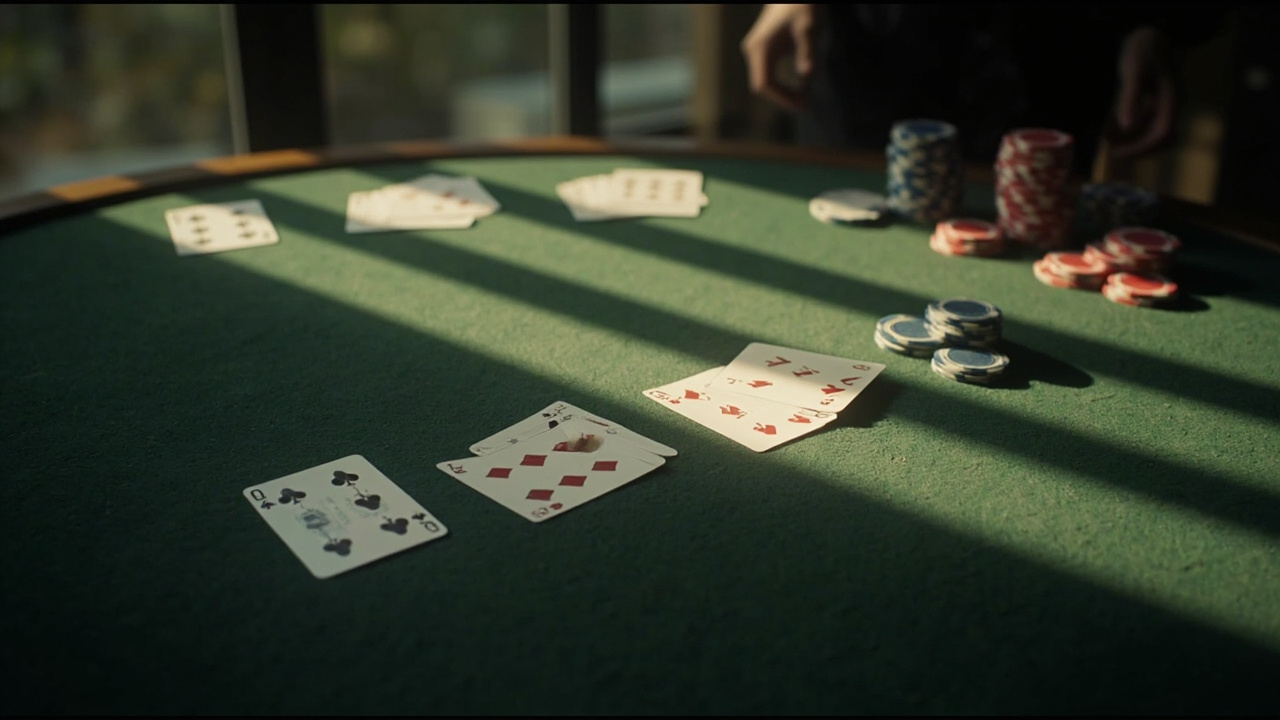
Points rummy: short, sharp, variance-tolerant
Each hand settles independently. Variance is high but session length is predictable.
Points rummy treats each hand as a discrete event. After a valid show, ungrouped cards carry point values: face cards, aces and jokers often weigh more than low pip cards. Drops are penalised by fixed amounts that depend on the table rules.
Players who can stomach one bad hand ruining ten careful ones often prefer Points because the feedback loop is tight. The cost is that a single late pick from the closed deck can erase good work.
- Sessions typically run 30–60 minutes with three or four opponents
- Drop decisions matter more than in Deals — a first-drop may be cheaper than a middle-drop
- Best for adults who want one decision per hand, not a long survival grind

Deals rummy: cumulative pressure over a fixed hand count
Scores accumulate over a fixed number of hands. Tilt risk grows with the cumulative total.

Deals rummy packages a fixed number of hands per session. Scores carry between hands, so an early deep loss is felt across the remaining deals. The pressure is cumulative rather than per-hand.
Players who recover quickly from one bad show find Deals rewarding; those prone to chasing losses often find the format punishing.
- Two or three deals are common; some apps run five or six
- Middle-seat information from repeated opponents matters more than in Points
- Consistent deadwood control beats a single heroic declare
Pool rummy: long survival, elimination thresholds
Chips enter a pool, ceilings eliminate players, and survival length becomes its own financial activity.
Pool rummy places entry chips into a shared pool. Players who exceed the elimination ceiling are knocked out. The format rewards longevity and disciplined drop decisions over individual heroic declares.
Because the session can stretch, Pool tables demand stronger session-time and stake limits than Points. Treat the entry chip as entertainment spending, not as recoverable capital.
- 101 and 201 pool tables are common variants
- Rejoin rules vary by operator — check the on-screen rule strip
- Pre-set deposit caps and session timers before joining
Side-by-side format comparison
Use this as a mental triage before opening a lobby. Always verify the on-screen table card.
| Format | Session shape | Variance | Decision density | Reader fit |
|---|---|---|---|---|
| Points | Short, sharp | High per hand | Frequent drops matter | Short attention spans |
| Deals | Medium, fixed | Medium cumulative | Steady pacing | Recoverable tilt |
| Pool | Long, elimination | Spreads across hands | Survival-focused | Pre-set limits essential |
Format choice and responsible play
Different formats carry different harm profiles. Skill framing does not erase time or financial risk.
Pool's long survival stretches time and concentration; Deals's cumulative pressure can amplify tilt; Points's sharp variance can push loss-chasing in a single hand. Choose a format whose pressure profile matches your real-world limits, not your optimistic self-image. Operators publish session-timer tools and deposit caps; use them.
How format choice shapes bankroll and attention
Adult readers who treat format as a cosmetic label usually discover the cost mid-session.
Points as a feedback loop
Points rummy keeps each hand independent. That independence is both the strength and the trap. A careful drop on hand three does not protect you from a late closed-deck pick on hand four. The format rewards adults who can reset emotionally between hands and who keep a running tally of face-card exposure without turning the tally into a superstition.
Stake selection inside Points matters more than most beginners admit. A table that looks “cheap” on the lobby filter can still punish an invalid declaration with a maximum deadwood value that erases several careful folds. Read the table card for the invalid-show penalty before you join, not after the first failed declare.
Deals as cumulative pressure
Deals rummy packages a fixed number of hands. Scores carry. An early deep loss is felt across the remaining deals even when the next deal looks clean. Middle-seat information from repeated opponents matters more than in pure one-and-done Points tables, because the same players sit across from you for the whole set.
Adults who recover quickly from one bad show find Deals rewarding. Adults who tilt after one bad show find the remaining deals expensive. The format does not create tilt; it amplifies whatever emotional pattern you bring to the table. Pre-set a loss limit for the entire set, not just for a single hand.
Pool as survival economics
Pool rummy places entry chips into a shared pool with score ceilings that eliminate players. Surviving longer can matter as much as winning individual shows. Drop rules and rejoin conventions vary by operator table — always read the on-screen rule strip before the first deal.
Because the session can stretch, Pool tables demand stronger session-time and stake limits than Points. Bring a timer. Bring a deposit cap. Treat the entry chip as entertainment spending, not as recoverable capital. A long survival grind is still a financial activity even when framed as skill.
Switching formats mid-evening
Some apps allow lobby switching between Points, Deals and Pool. Switching usually resets KYC timers only in edge cases, but it can affect bonus lock-ups. Read the bonus terms before you treat a format switch as free. If a bonus requires N hands of a specific format, switching out of that format mid-lock-up can void the reward.
A practical evening plan for adult readers is to pick one format, set one timer, and leave when the timer ends — win or lose. Format hopping mid-session is usually a tilt signal dressed up as strategy.
Reading the table card before the first hand
Every modern rummy lobby publishes a table card (sometimes called a rules strip) that names joker type, drop scores, invalid-show penalty and whether printed jokers differ from wild twos. Table text beats memory from another app. Adults who skip the card and rely on last week’s recollection regularly discover that a middle-drop value has changed.
Three checks take under twenty seconds: (1) drop values for first, middle and last drop, (2) invalid-show penalty, (3) joker behaviour. If any of the three is missing or unclear, open a support ticket before depositing. Ambiguous table cards are a safety risk, not a feature.
Stake bands on the lobby filter are not the same as the maximum exposure on a single hand. A low entry fee can still carry a high invalid-show penalty. Read both numbers before you join.
Bankroll notes that survive real evenings
Skill framing does not erase variance. Closed-deck order and hidden opponent holdings remain uncertain no matter how carefully you sort for a pure sequence. Adults who size stakes as a percentage of a pre-set entertainment budget survive more evenings than adults who size stakes as a percentage of last night’s win.
A workable rule for many adult readers is: never sit a table whose maximum single-hand loss exceeds two percent of the weekly entertainment budget. The rule is arbitrary. The discipline of having a rule is not. Without a rule, stake selection becomes a mood decision, and mood decisions compound under tilt.
Track sessions in a private notebook for two weeks. Note format, stake band, session length, net result and the single decision you would reverse. Patterns appear faster on paper than in memory. The notebook is not a system for beating the closed deck. It is a system for noticing when your own habits are the expensive variable.
Format questions, editor answers
Which rummy format is best for short sessions?
Points rummy keeps each hand independent with chip-value settlement, making short sessions straightforward. Length still depends on table turnover.
Which format punishes slow play the most?
Pool rummy carries elimination thresholds across many hands; long survival grinds pressure concentration, time and stake.
Do all formats require a pure sequence?
Indian rummy tables universally require at least one pure sequence before a valid show, across Points, Deals and Pool variants.
Are stake limits visible inside the lobby?
Most operators display stake bands and entry fees on the lobby filter. Verify the exact entry fee and maximum drop penalty before joining.
Can two formats be played in the same session?
Some apps allow lobby switching, but switching usually resets KYC timers and may affect bonus lock-ups. Read the bonus terms first.
How do wild cards differ between formats?
Printed jokers are usually universal. Some apps offer wild-two promotions; treat any promotion as table-specific and not as a general rule.
Is this guide sponsored by the operator?
No. This is independent editorial work. The commercial CTA at the bottom uses a disclosed first-party redirect that may earn a commission.
Does the commercial button change the rule information?
No. Rules are verified against the operator screen and the publicly available rule strip. The CTA is unrelated to the technical accuracy of the content.
Are the listed stakes and limits guaranteed?
No. Stake ranges, drop values and invalid-show penalties change with each operator update. Always read the on-screen table card before joining.
How often is the hub updated?
Editorial notes are reviewed each quarter and updated whenever a relevant rule or product change is verified. Dates appear on the methods colophon.
Compare formats on the live cricbaba lobby
After reading the format notes, the next step is opening the live table card. The lobby shows the actual stake bands and rule strips at the moment you join — never rely on a third-party screenshot.
PLAY NOWDisclosed first-party route. Editorial notes are independent of the commercial relationship.